
29 April 2026
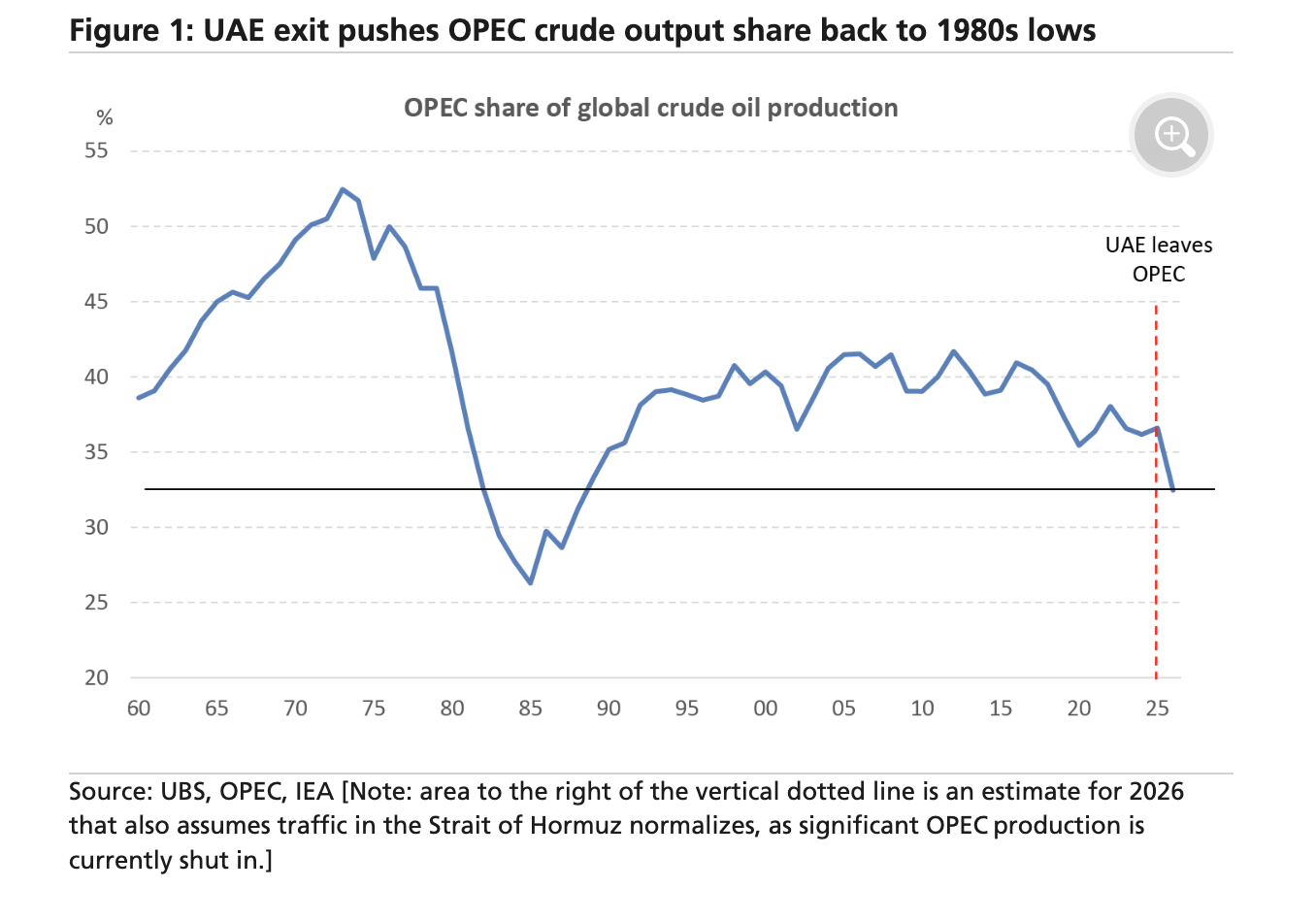
UAE exit pushes share of global crude production to 1980s level
The UAE’s announcement that it will exit OPEC, effective 1 May, will reduce the group’s share of global crude production from around 36.6% to roughly 32.5% — its lowest level since 1988. As oil and energy colleagues have noted, the UAE is not the first country to leave the cartel: Qatar and Angola both exited in recent years. However, the UAE is OPEC’s third-largest producer and accounts for the second-largest share of spare capacity, around 25% of the total.
The immediate impact on oil prices is likely to be limited. Production increases cannot materialise until additional volumes can be shipped through the Strait of Hormuz. That said, a number of significant projects had been scheduled to come on stream, potentially lifting UAE crude output from around 3.6mb/d pre-conflict to close to 5mb/d by 2029.
More broadly, the steady erosion of OPEC’s share of global oil supply — driven in recent years by the rise of US shale production and by OPEC’s own output restraint to support prices — will complicate the group’s ability to manage market balances. Over time, this is likely to increase price volatility.
The UAE’s departure also further concentrates influence within OPEC. Saudi Arabia’s share of the group’s production rises from around 35½% to roughly 40%, a level not seen since 1981, increasing the burden on Riyadh to act as the cartel’s effective swing producer.
 Προσθήκη του MarketsReport.gr στην Google