
CITI’S TAKE
Andy Burnham’s local election win opens up a challenge to PM Starmer. While timing remains uncertain, Citi economists’ see any leadership change as more likely later in the summer. Burnham has thus far given little steer on policy, but his premiership would likely imply higher borrowing and potentially higher gilt yields. For equities, higher yields support FTSE 100 outperformance over the more rates-sensitive/domestically-focused FTSE 250. At the sector level, Real Estate and Utilities face headwinds from higher yields, while Financials and Energy tend to benefit in relative terms. Our prior screen of rates-sensitive UK stocks with deteriorating EPS momentum has underperformed year-to-date and has staged only a limited recovery over the past few weeks. Based on prior betas, a move in 10-year gilt yields back to recent highs could imply 5-10% downside for the group.
Andy Burnham’s Makerfield by-election win opens his path to challenge PM Starmer, though the timing of any leadership contest remains uncertain. Citi economists think a successful leadership challenge would most likely resolve later in the summer (e.g., September), but a faster route to a Burnham premiership cannot be ruled out. Citi rates strategists see a “swift coronation” scenario for Burnham as supportive for gilts near term, aided by political stability. A longer leadership contest would prolong uncertainty, increase fiscal scrutiny, and most likely weigh on the gilt market.
Longer term, a possible Burnham premiership would likely imply higher borrowing, even if fiscal rules are maintained. While Burnham would likely frame such issuance as “good borrowing”, markets may nevertheless remain focused on increased supply. The Rates Strategy team ultimately warns that political uncertainty could weigh on gilts for months, potentially pushing 10-year yields toward a 5–5.25% range or higher. As Citi economists have noted, Burnham has given little steer on broad policies, though he likely favors nationalization of key industries like water, and has been vocal in his calls for a reform to property taxation. For more detail, see: UK Economics – The Return of the ‘King’ (of the North)
Higher gilt yields could have meaningful implications for UK equities. In line with previous findings, we would highlight a few key takeaways for UK equity indices, sectors, and stocks:
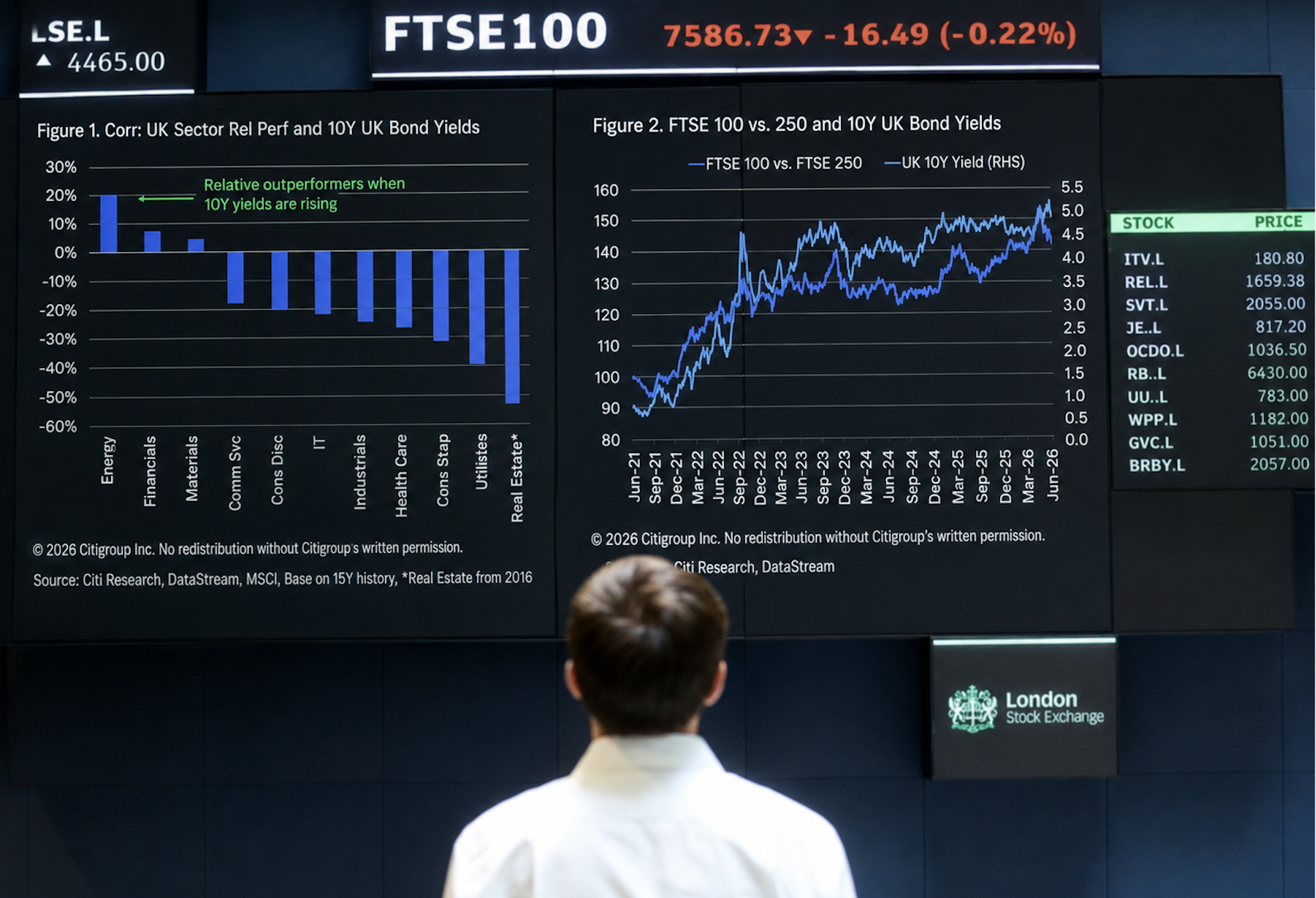
Index level: The more domestically focused FTSE 250 tends to be more sensitive to rising rates and typically underperforms the internationally oriented FTSE 100 in a rising-yield environment (Figure 2).
Sectors: Higher yields are generally a headwind for rate-sensitive sectors such as Real Estate and Utilities, while Energy and Financials tend to benefit (Figure 1). Within this backdrop, we favor Banks, Basic Resources, and Healthcare.
Stocks: We have previously screened for rates-sensitive UK stocks with deteriorating EPS momentum (exposed to rising rate pressures and earnings downside). The screen has underperformed meaningfully YTD and has staged only a limited recovery over the past few weeks (Figure 3). We re-run the screen in Figure 6 with relatively few changes since May. Based on sensitivities over the past year, we estimate that a rise in 10Y gilt yields back to recent highs (c5.2%) could lead our rates-sensitive screen 5-10% lower (Figure 4).
Earnings: The FTSE 250 has seen downgrades to EPS growth forecasts year-to-date, in contrast to the FTSE 100, where earnings expectations have been meaningfully revised higher—largely driven by the Energy sector (Figure 5). We continue to favor UK Large caps over Mid-caps.