
European Equity Strategy/CITI’S TAKE
The interim peace agreement has triggered a further relief rally in European equities, extending the rebound seen in past weeks. The STOXX 600 is trading at all-time highs, suggesting that a meaningful portion of geopolitical risk premium has already been priced out. However, index-level strength masks a more uneven recovery beneath the surface, with a broad range of sectors and stocks remaining below pre-conflict levels. This dispersion creates scope for a second phase of the recovery, characterised by greater rotation and market broadening. This remains possible over the near-term as positioning readjusts and fundamental headwinds abate. However, the AI theme is likely to remain the key structural driver, backed by fundamental strength/momentum. Germany and Sweden appear therefore most attractive on a tactical horizon, alongside consumer-related sectors, particularly Autos, while Tech remains a key Overweight in our sector strategy. We also reassess the fundamental outlook in Europe to identify longer-term opportunities.
Performance Dispersion: Since the initial ceasefire announcement in April, performance dispersion across equity markets has remained elevated. Technology-heavy and AI-exposed regions, such as Korea and the US, have outperformed, while markets like Australia and Hong Kong have lagged significantly. European equities have only recently unwound earlier losses. This has been closely matched by investors’ positioning. Within Europe, several areas, including parts of Consumer, Industrials, and certain Defensive sectors, continue to trade below pre-conflict levels. At the country level, Germany, the UK, Sweden, and France also remain below their pre-war benchmarks.
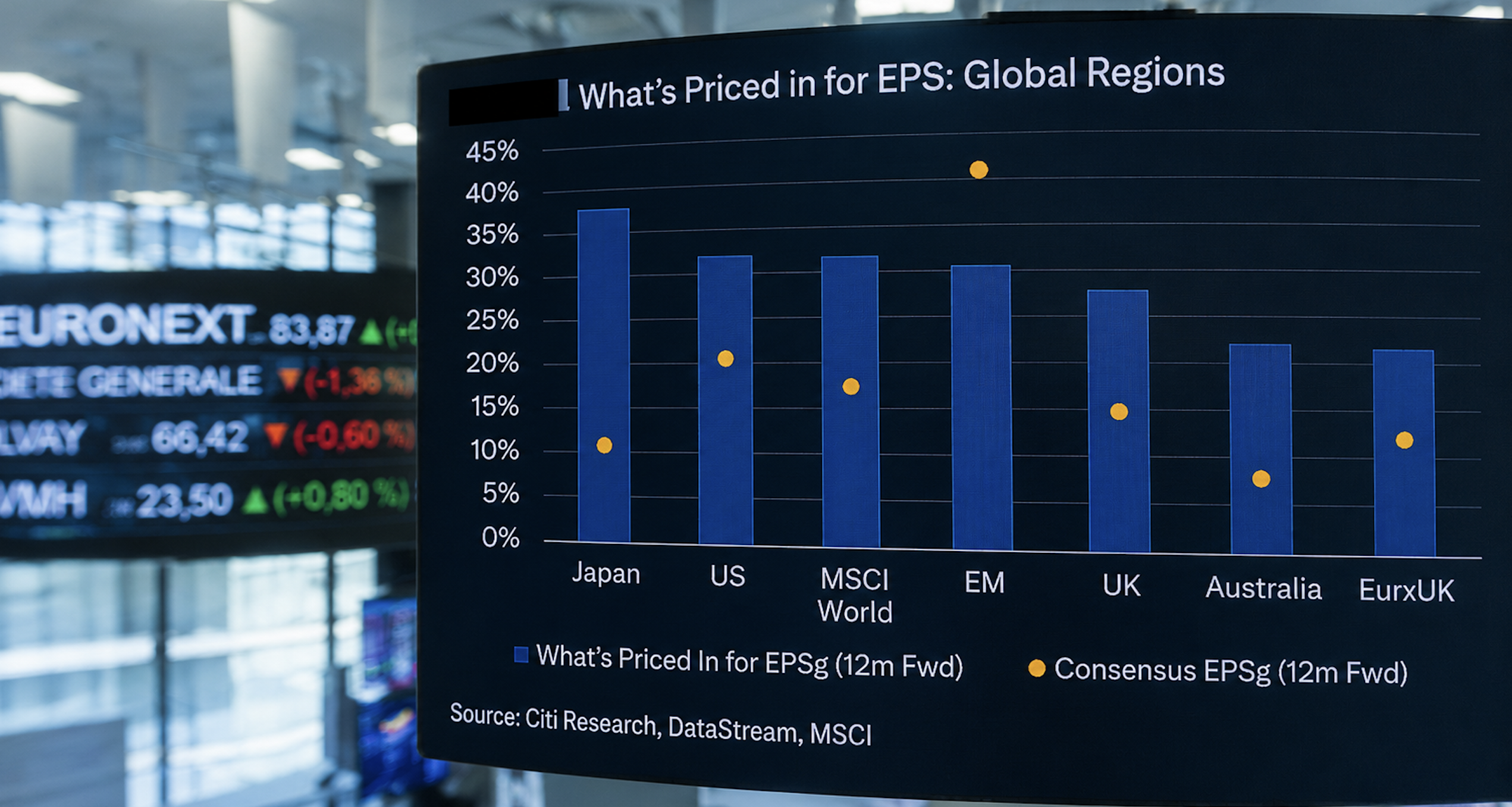
Peace opportunities: We screen European equity sectors and countries using a composite ranking framework that combines four signals: (i) 12-month forward P/E de-rating since the start of the US–Iran conflict, (ii) short-term (one-month) earnings momentum, (iii) relative performance since the onset of the conflict, and (iv) long/short crowding based on Citi’s Quant team indicators. At the sector level, Health Care Equipment, Autos, and Personal Care rank highest in our composite screen. In contrast, Consumer Services and Semiconductors score relatively poorly. Across European markets, Sweden, the UK, and Germany emerge as the most attractive on our ranking, while Italy, the Netherlands, and Spain lag behind. What’s pried in by the market: Our proprietary What’s Priced In model offers a complementary lens by estimating the EPS trajectory currently implied by market prices. Only Emerging Markets are priced for downgrades. The US has moved closer to fair value relative to analysts’ consensus expectations, while more cyclical markets such as Japan and Europe remain priced for upgrades. Beneath the regional aggregates, however, the European sector picture is notably more heterogeneous. Commodity-linked sectors are priced for the largest earnings upgrades. By contrast, the market appears more cautious than consensus forecasts in several areas, including Consumer Durables (including Luxury Goods), Household Products, Health Care Equipment, Commercial Services (including Media), Real Estate, Software and Semiconductors.